The Era of AI Psychosis


AI psychosis, as I’ve come to learn from my own personal experience, is the observed change in behavior and thinking of the tech industry at large. It’s the belief that more can be done with less, that anything with a moat can be quickly vibe coded, that software is as disposable as the thoughts coming and going from your brain.
Wikipedia describes AI psychosis as “individuals reportedly develop[ing] or experienc[ing] symptoms of psychosis, such as paranoia and delusions” through the use of AI chatbots. Wikipedia, AI-induced psychosis
Preface
First, I want to make one thing clear: AI is a force multiplier. You’re now able to get way more done using Claude, ChatGPT, Gemini and many other large language model interfaces. You can organize your work into repeatable patterns that these tools can remember, and use that memory to build out your ideas faster, with less setup, and with some degree of accuracy. Under this new model, you’d think we’d be churning out advances in medicine, improving critical government systems, and overall improving our standard of living. While some of that is happening (see Moderna), what we have instead is a massive reduction in force of the overall tech and wider community.
Symptom one: more can be done with less
Take a look at the following four layoff announcements from this year. I had the amazing opportunity to be on the wrong end of the first one, but no hard feelings. Take a note of the tone, approach, and delivery of each.
@jack on X, February 26, 2026
@brian_armstrong on X, May 5, 2026
@fedesimio on X, October 12, 2026
They have a few things in common:
- They look like they’ve taken a template and just retrofitted their own wording around it. None of these declarations of reductions in force are original or thought leading in any way.
- There’s always some sort of being “grateful” for those impacted, as if that’s supposed to help lessen the blow of you losing your job.
- “More with less” and “move faster” are the prevailing themes.
- “Generous packages” and “hire these people” give the people let go credibility while lessening their impact at the same time.
A question for every leader who declared their employees redundant seemingly overnight: if these tools really speed up productivity, why do more with less instead of more with more? To me, that choice reveals a lack of consistent product vision and focus. A team with a real roadmap would use a tool that makes them several times faster to get further down that roadmap. Instead, the response has been to gut teams, processes, and products. That screams private equity or investor pleasing rather than efficiency. But I digress.
And another thing, if the company is seemingly doing “well”, and profits are “increasing” with the people you already have, wouldn’t you want to increase profits more, by building more revenue generating products, or tightening revenue losing infrastructure?
Symptom two: any moat can be vibe coded
@marclou on X, October 15, 2026
There are different reasons why developers are cloning paid software using AI tools. And yes, I mean cloning, because whether or not these are clean room implementations, these developers did not originate the ideas or interfaces they rebuilt.
One reason is that people are tired of being trapped into tricky subscription models that are hard to cancel, or charge excessively. The other reason is more “bravado”, in the sense that a solo developer, usually with a large following (and a blue check, cough, cough) believe that they alone are better than the sum of the parts, battle tested experience and engineering teams that put their time and effort to make resilient software for their audiences.
Symptom three: software engineers are disposable
Based on the news alone, you might believe these layoffs have all of a sudden taken place because of the rise of AI. That is partly true at best, and mostly false at worst. What do I mean?
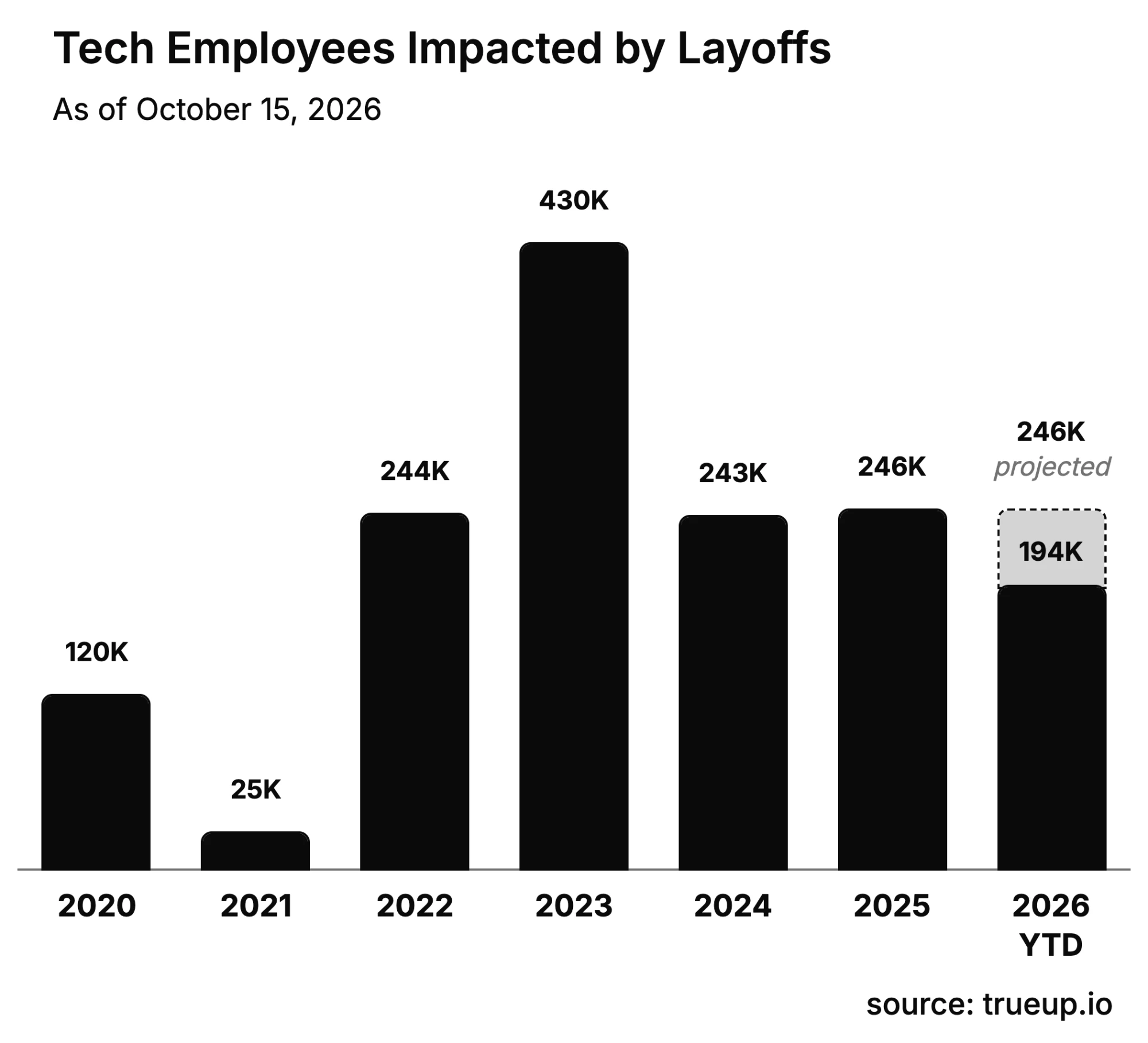
As you can tell, tech layoffs have been steadily rising and then flattening throughout these years. What you might not know is that ChatGPT wasn’t officially introduced until November 30, 2022.
@sama on X, November 30, 2022
So, what gives? Everyone knows ChatGPT in its early days was nowhere near good enough to replace anyone, much less creative work. My answer to this is convenience: due to the tightening of interest rates, and changing economy, it became more expensive to maintain hiring and headcount at the levels we saw during the pandemic, and post-pandemic.
The Federal Reserve began raising rates in March 2022. The peak year for layoffs, 2023, arrived while ChatGPT was barely a year old and nobody was shipping production code with it.

As you can see, with the rise of interest rates, comes a loss in jobs. In that light, AI becomes a convenient reason for cuts that were either planned or delayed in anticipation of more favorable market conditions.
You may now say “ok, what’s your point?” My point is that anyone at any time is expendable, not just software engineers, and just because they are expendable doesn’t mean the work that they did was unimportant. Google could fire 90% of its workforce and still run, but does that mean the work of all 90% was useless for 100% of the time they were employed? Retail investors love to think so, but that’s not the case in reality. You need to keep up with advances in the world around you, and you need people to do that, point blank period. Being able to be without because you couldn’t afford them on the balance sheet says nothing about their ability to get things done or contribute. If they weren’t necessary, they wouldn’t have been hired in the first place.
Why “psychosis” and not “hype”
Why psychosis and not hype? Well I think two things can be true at once, and that’s what’s really happening. Leaders are engaging in psychosis caused by the hype around AI, but the way in which they’re going about it represents a collective psychosis regarding layoffs. Each layoff post I referenced has a similar muted tone, delivery, and talking points. It’s almost as if they were all possessed by the AI and told to communicate layoffs like a series of falling dominoes, with the gaps between dominoes standing in for the weeks between announcements. Or maybe, one wants to be seen as the one that caused the dominoes to fall, and it’s more about how visionary they look versus anyone else.
What’s actually true
In a time of unfavorable market conditions, anything that can be used to bolster the bottom line will be cut. You as an at-will employee are the easiest thing to cut from the balance sheet. That, and that alone is it. If there ever comes a time where it becomes more expensive to use compute than it is to hire people, we’ll see a steep reversal of this trend.
What recovery looks like
I’m not gonna pretend I know if, or when there’s a reversal of this trend regarding AI. Any answer to this will come as a result of innovation, legislation and rising competition due to the ability to build ideas in real time.
Closing
If you’ve made it to the bottom of this article, I’d like to thank you for your time. I try my best to remain truthful and unbiased to what’s happening around us. If you have anything you’d like to say, positive or negative, please leave a comment, but be respectful. Until next time!1
-
Claude Fable was used to create this post, but only to format it and insert media. The argument and prose are mine. ↩
Loads Disqus, which sets third-party cookies.